
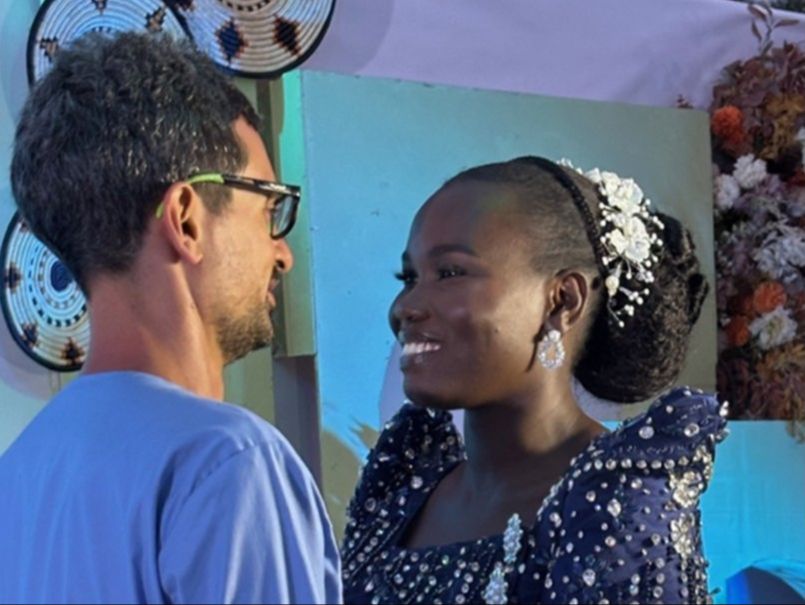
Once we've finished our business, we attend a wedding before heading home.
On Saturday, at the home of Titin Albina, Jacopo's bride, we are welcomed by a group of traditional dancers. At the end of the driveway, local children have gathered to enjoy a glimpse of the party.
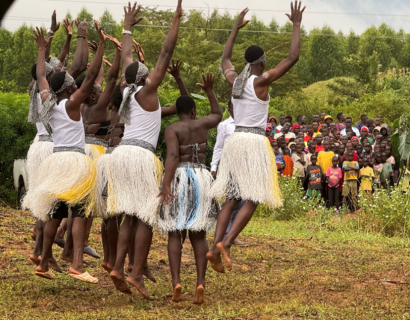
This area south of Soroti, where the bride is from, is the territory of the Teso people, who speak an Eastern Nilotic language. In 1902, the British colonial regime divided the Teso territory in two: the eastern part was ceded to Kenya, thus dividing this people into two different states.
The ceremony is wonderful.
On the previous day before, the ritual bargaining took place, in which the compensation that the groom owes to the bride's father is agreed upon. Once this phase has been successfully completed, the next day there is the ritual of ‘presentation’ to the bride's family, guided step by step by a master of ceremonies dressed in a traditional cloak over a suit and tie.
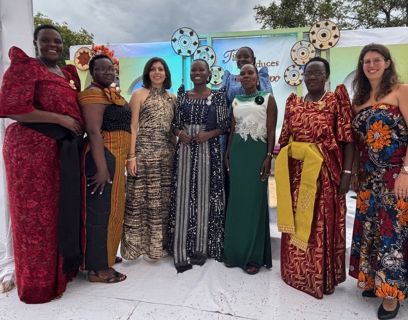
The bride, center, posing with the Lacor women’s team: from left to right, Betty Lajara P'atingo, Jackie Amony, Giulia Monti, the bride, Grace Apiyo, Rose Grace Ayoo, and Carolina Laghi.
The bride and groom practically do not see each other throughout the ceremony, including the banquet. In fact, the groom's friends and the bride's friends keep them hidden from each other, and only (almost) at the end do the two spouses meet.
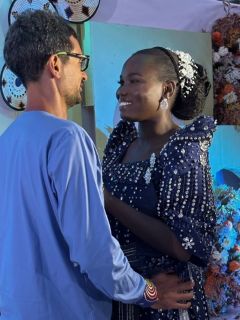
The bride, dressed in a magnificent traditional Ugandan “gomesi”, kneels before her parents and presents the groom. Her parents then give their consent and blessing.
The bride can then change her dress and don a stunning white gown adorned with traditional jewelry. Holding a traditional scepter, a symbol of fertility, she accepts a ring presented by the groom and blessed by a church representative.
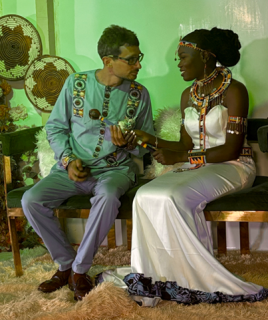
Finally, seated on a small throne, the bride and groom receive wedding gifts, accompanied by singing and dancing.
Early the next morning, we set off for Entebbe airport.
It is just under 300 km on a paved road that runs southwest from Mbale, but Google tells us it will take five hours.
We are particulartly concerned about the terrible traffic jams in Kampala where, before getting on the Northern Bypass, the outer ring road that circles the capital to the west, the rist of being stuck for hours is very real.
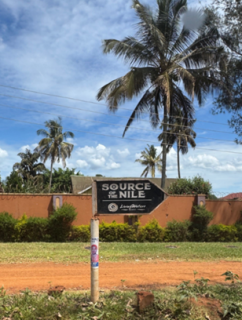 In Jinja, I ask if everyone agrees to make a short detour to the source of the Nile. At this site, the Victoria Nile, or White Nile, flows out of Lake Victoria and begins its 6,600 km journey towards the Mediterranean sea.
Within 5 minutes, we park the car and head down to the bank of the great river.
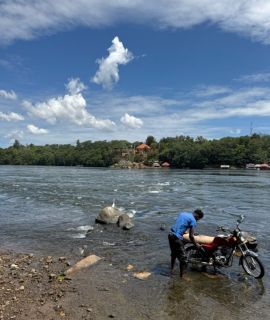
Towards the north, a young man washes his motorbike in the water with the help of a stubble brush, which he periodically beats with a stone to break it down.
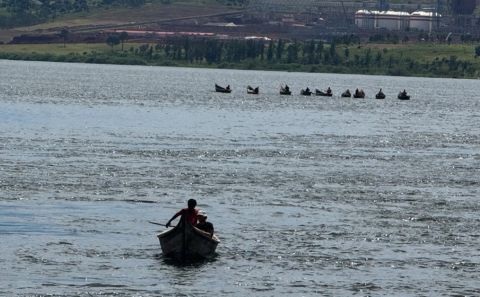
Southwards, silhouetted against the light and by a thousand sparkles, fishermen in the typical long, tapered boats are trying to earn their daily bread with great effort.
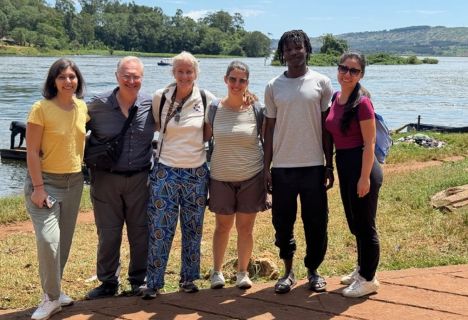
We take a photo with the Nile in the background. Behind us, Lake Victoria is hidden by a bend in the river.
We resume our journey towards Entebbe and the flight that will take Contardo and I back to Italy tonight.
Carolina will follow us 24 hours later, while Giulia will take the opportunity of her sister’s husband who works in Cairo for a short visit to Egypt before continuing to Italy for her Christmas holiday.


