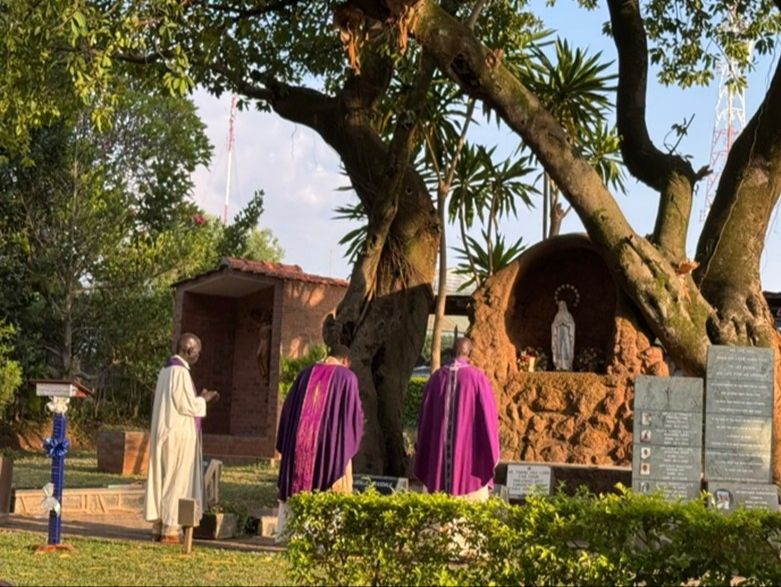
On December 5, the date of Dr. Matthew Lukwiya's death, a commemoration is held for all our staff members who died of Ebola, my parents, Brother Elio, Dr. CP and, of course, all the Board Members and Donors who are no longer with us.
It is a precious opportunity to recall the reasons and values that remind us of “those who have gone on,” as our dead are referred to here. The celebration is held in front of the graves, in the heart of the hospital, beside the grotto of Our Lady of Lourdes.
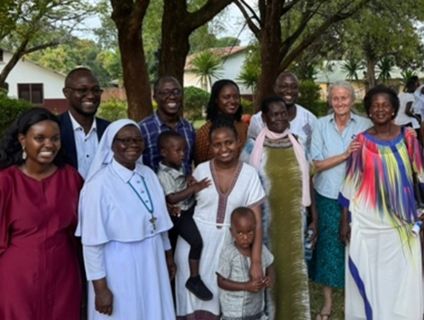
This time the entire family of our national hero Dr. Matthew, is present. Margaret, his wife, never misses this occasion, is accompanied by her eldest son Peter, a lawyer, the twins Paul -a nutritionist- with his wife and two young children, who never knew their grandfather; and Daniel, a pediatrician with his wife, a gynecologist.
I speak in Acholi: people expect this of me. I explain that otherwise the chaplain, Father Romano, would scold me severely. This provokes general hilarity, given that Father Romano is one of the mildest people I know.
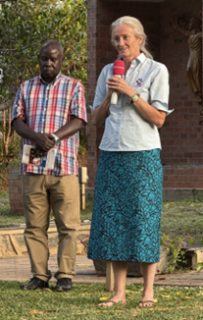
I also remind everyone that Dad wanted to be buried in the heart of the hospital so he could pull the ears of those who misbehaved…
Last night at Lacor. An ambulance brings a patient to the emergency room.
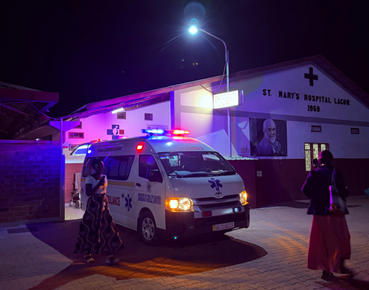
Despite the late hour, there is still a lot of movement in the avenue that passes in front of the maternity ward and leads to the pediatric ward.
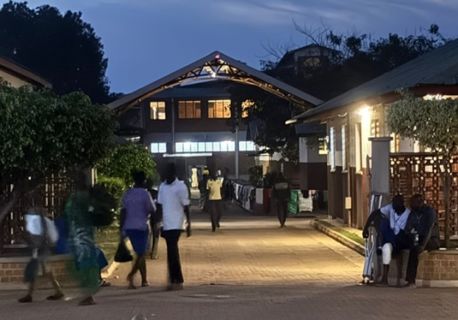
As usual.
The next morning we leave for Mbale, where we will stay for the traditional wedding of Jacopo, the Corti Foundation engineer deployed to Lacor Hospital since 2019 as Deputy director head of the large Technical Department.
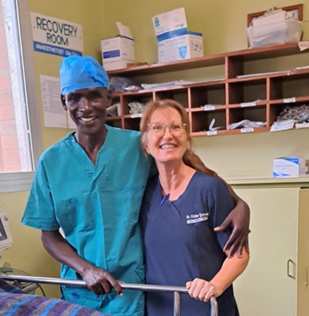
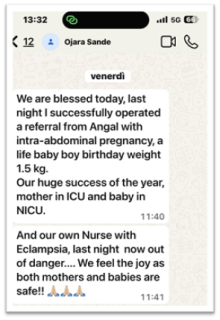
At breakfast, Cristina Reverzani, who has specialized in obstetrics and gynecology in Uganda almost one year ago, tells us that the previous evening she assisted the gynecologist Dr. Ojara Sande, who is now also a lecturer at Gulu University, during an exceptional operation.
It was an abdominal pregnancy, a rare form of ectopic pregnancy (1-2% of all pregnancies are ectopic; of these, only 1-2% are abdominal). The fertilized egg fails to reach the uterus, and the placenta develops by adhering to nearby organs. Normally, such a location does not allow development of the fetus.
A few hours later, I receive the message on the left from Dr. Ojara: