The smooth running of a large hospital such as St. Mary's Lacor does not depend solely on the work carried out in the wards, corridors and operating theatres. It also originates elsewhere: behind a desk, in a carefully affixed signature, in a discreet check that no patient will ever see, but on which the daily efficiency of the entire hospital depends.
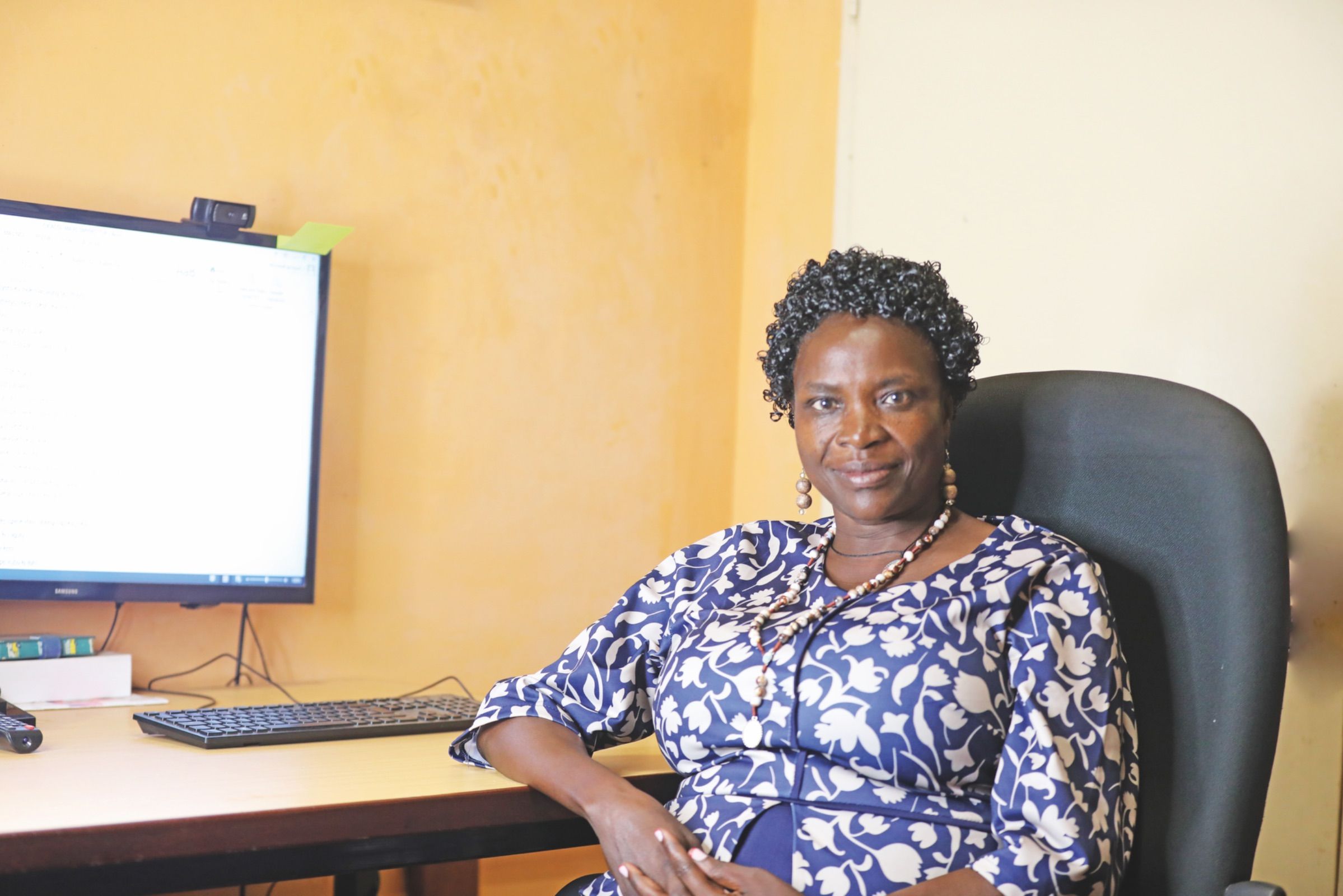
Iris has been working at the Hospital since 2000.
She grew up in northern Uganda during the war years. While studying in Kampala, some of her classmates from Sacred Heart School in Gulu were abducted: one night, rebels entered the dormitories and captured 45 girls, while Iris survived by hiding until morning. After completing her studies, she returned home to find that her family had been displaced, forced to flee rebel raids. These experiences strengthened her character and determination.
In 2000, after obtaining a degree in business administration, Iris began working at Lacor Hospital as a cashier. "Here, I learned that the hospital's operations also depend on those who never set foot in the healthcare departments." Over time, she has grown professionally, taking on increasingly important responsibilities in an ever more complex environment.
Today, Iris coordinates the work of the payment counter staff spread across the hospital and health centres: more than 20 people to organise, shifts to manage every day, and cash flows to control. Her work begins with preparing tasks for cashiers, whom she supports through monthly meetings, and continues each day with checking receipts, invoices, reimbursements and receivables.
It is work that requires accuracy.
" A single lapse in attention is enough to cause problems," she explains. "Behind every figure, there is a service that must continue to function." And every mistake carries weight, because behind it there is always a health service, a medicine, or a treatment that must continue. Solid administrative management is essential to enable the Hospital to fulfil its mission of providing care at the lowest possible cost to more than 200,000 people per year.
In general, hospital care is subsidised by 70% because the client population is very poor. Certain vulnerable groups, such as mothers and children, receive much higher subsidies (for example, hospitalisation for a child under 5 costs 10,000 UGX — approximately 4 $CA — with the exception of certain specific medicines that must be paid for separately; for a normal delivery, the cost is 25,000 UGX — about 10 $CA). Without this balance, built day after day thanks in part to Iris's work, the hospital would not be able to continue treating those who arrive with very little money.
Managing resources effectively in a fragile environment is not always straightforward.
The ability to best fulfil this responsibility is also rooted in her personal history. When Iris talks about Lacor Hospital, she describes a hospital that has always been a point of reference for the community, a place where people go when there is no other option. "For the community, Lacor Hospital is a home, a precious presence," she emphasises.
Alongside her daily work, Iris has set up an internal solidarity fund that brings together around thirty people from the hospital and surrounding centres. "We contribute 5,000 shillings per month, about two dollars. At the end of the year, that amounts to nearly two million, which we use to cover unexpected expenses, such as bereavement or family difficulties." In this way, she and her cashiers have become a small community that supports one another.
"Lacor Hospital? My home, my family." With her salary, she supported her brothers, sisters and nephews through school; through the hospital's credit union, she was able to buy land and build her house.
As an employee, Iris is entitled to health subsidies and protections, such as screenings, check-ups, vaccinations, treatment and sick leave. "When I needed daily treatment, the hospital was there for me," she says.
Lacor Hospital represents a concrete form of care, both for patients and for those who work to keep the hospital running.