This article addresses issues that are barely touched in Canadian news coverage. It will give perspective to the important work we are supporting with your help at St. Mary's Lacor Hospital.
Many of you have been asking for updates on the outbreak of Bundibugyo Ebola in the Democratic Republic of the Congo (DRC) and Uganda, a rare strain for which there are currently no approved vaccines or specific treatments.
The main outbreak has been located in Ituri Province, in the DRC. As of Monday May 25, seven cases were confirmed in Uganda’s capital, Kampala, linked to individuals arriving from the DRC and to their contacts. Ugandan health authorities immediately activated nation-wide the established response measures:
-
Early case detection by strengthening the rapid identification of suspected symptoms (such as fever, vomiting, diarrhea, bleeding, and sudden deaths), which must be reported immediately to health authorities.
-
Contact tracing: all individuals who have had contact with suspected or confirmed cases are identified, registered, and monitored daily for 21 days to check for the development of symptoms.
-
Laboratory surveillance: the laboratory network has been strengthened to test suspected samples.
-
Border surveillance: health screening, collection of information on travelers, and monitoring of movements at major transit points.
-
Community surveillance: community health workers, volunteers, and local leaders report suspected illnesses, unusual deaths, and support awareness and prevention activities.
-
Infection prevention and control in health facilities: monitoring the use of personal protective equipment (PPE), healthcare worker safety, the availability of isolation areas, and compliance with infection-control procedures.
-
Surveillance and investigation of outbreaks and sudden deaths: monitoring clusters of fever or hemorrhagic symptoms and activating safe burial procedures to reduce the risk of transmission.
-
Regional and international coordination: collaboration with the World Health Organization (WHO), Africa Centre for Disease Control, the DRC, and humanitarian partners to share epidemiological and laboratory data, as well as information on the movement of at-risk contacts.
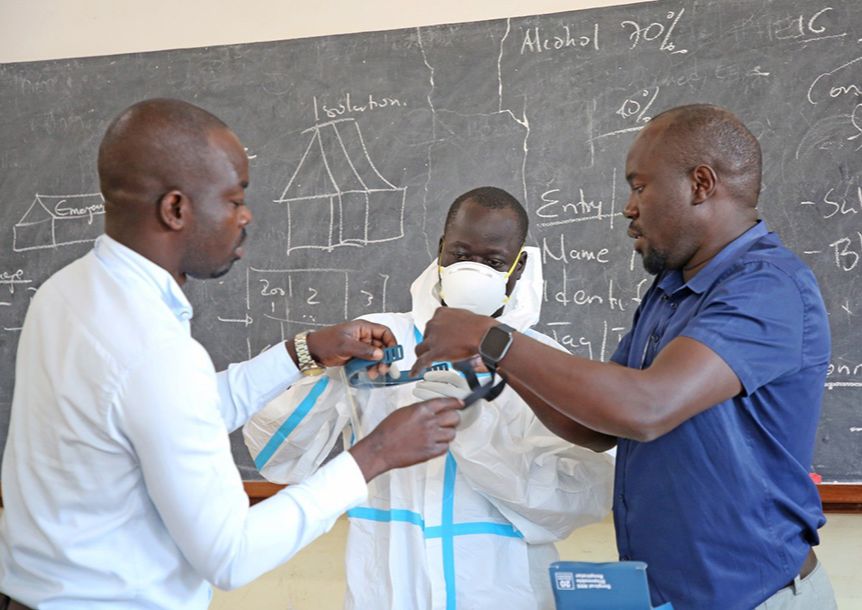
At Lacor Hospital, vigilance is also high. Staff participate in training sessions to strengthen surveillance, recognition of suspected cases, isolation procedures, and protection protocols, which must be practiced repeatedly until they become second nature. Stocks of personal protective equipment are being reviewed, and Fondazione Corti has already provided an initial allocation of 18,000 EUR (30,000 CAD) to replenish supplies as needed.
As Dr. Emmanuel Ochola, epidemiologist and Scientific Director of Lacor Hospital, reminded us: “In combating epidemics, prevention is the first and most important shield. Experience has taught us that being prepared in advance means earning people’s trust and saving lives.”
Ebola becomes contagious only when symptoms appear, such as fever, and it is at that point that authorities should require isolation and conduct tests to determine whether the illness is Ebola or another condition, such as malaria or gastroenteritis. There are certain countries that have actually adopted these practices. Canada is not one of them. In these countries, like Italy, local health authorities monitor travelers from the DRC and Uganda daily from the moment they arrive until 21 days have passed, the maximum incubation period of the Ebola virus. Canada requires isolation from the time of arrival, regardless of the traveler’s health status.
At times like these, it is important to pay close attention to the quality of the information being shared. Sensational or rushed headlines can unnecessarily create fear and confusion.
As a precautionary measure, students, medical residents, and interns who were at Lacor Hospital have been recalled by their universities.
Since 2000, when Lacor Hospital stood on the front line of containing the devastating Ebola epidemic that struck Uganda for the first time, vigilance, prudence, and continuous strengthening of skills and protocols have built a wealth of experience gained in the field.
Today, Lacor Hospital continues to care, prevent, and protect—even in the most challenging circumstances. The two foundations (Fondazione Corti and Teasdale-Corti) remain, as always, close to Lacor Hospital, its Ugandan and expatriate staff, providing financial support and whatever additional assistance may be required.
Having you by our side is essential.
With gratitude for your continued support,
Dominique


