
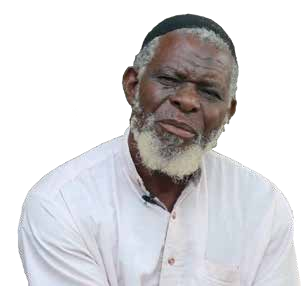
Mzee Tabliq, a.k.a. Yusuf Abbas, gives his life to ferrying people who want to go to St. Mary's Lacor Hospital.
For those of us who live in Canada, going to the hospital is easy. In our large cities, like Montreal and Toronto, there are many hospitals. Public transportation serves all the city’s hospitals, a taxi is always available, and in case of an emergency you can dial 911, and an ambulance will come. However, in Uganda, if you have a severe illness and need to go to the hospital, your journey can be very long, expensive, and you might even have to borrow money to reach the hospital, even before starting your treatment.
Between illness and hope, there is this journey.
In Gulu, near the hospital entrance, we see a “matatu,” a minibus from which about twenty patients are getting off: men, women, children, each with their little bundle, heading towards the outpatient department entrance.
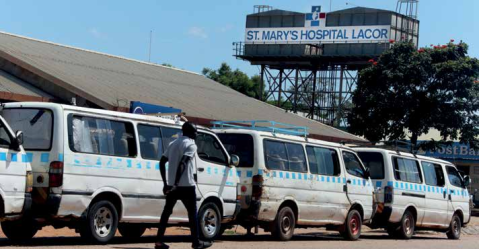 Santo Uma, the hospital’s engineer, points out to us: “You see? It comes from Lira, 100 km southeast of Gulu. It’s driven by a Mzee [honorary title for a respected older man] who brings patients from his town to Lacor Hospital every morning. He does it at cost, out of solidarity with the patients and gratitude towards Lacor Hospital.” Alfred, the Hospital’s communications manager and son of Daniel, one of our nurses who died of Ebola in 2000, managed to get a few words out of him.
This is his story.
Yusuf Abbas, known as Mzee Tabliq, lives a quiet and peaceful life in the 1980s on the outskirts of Lira town with his wife and eight children. Subsistence farming was a significant part of his daily routine until a serious illness disrupts his life. He needs complex surgery. In the region, isolated from the rest of the country after the fall of Idi Amin, Lacor Hospital was the only establishment capable of performing complicated procedures.
After being bounced from one medical facility to another, Yusuf finally arrives at Lacor Hospital. He does not know that he would begin a journey that continues to this day. When he arrives, his life is in danger. He has to be urgently taken to the operating room, where he is operated on and recovers. "I saw the kindness of Lacor when I was brought here for the surgery. Lacor doesn’t sell oxygen or ask for under-the-table payments. When you’re operated on, there are four or five doctors, and when one is in trouble, they consult each other, not like elsewhere," he remembers.
In 1983, Yusuf becomes a truck driver. After the liberation war by the National Resistance Army (NRA), he starts coming to Gulu as a taxi driver. "I take people to Lacor because it is blessed by God. Most of the people I take to Lacor survive in most cases, unless their time has come," he tells Alfred. Over the years, Yusuf has brought thousands of people to Lacor. And he teaches his children to do the same. Most of his customers call him. "I don’t know how they get my number," he confesses.
Yusuf has a fixed parking spot in Lira, his town, where his "customers" can find him. Most come from more distant places, like Kaberamaido, Soroti, Amolatar, and other places over 300 km away. Yusuf welcomes them to his home for the night, where his large family awaits them with a warm meal. "I accommodate between 12 and 14 people every day. We leave Lira around five in the morning. Most of them don’t know the place, so I bring them to the gate," he says.
Yusuf, a devout Muslim, does not charge for the evening meal or accommodation. During the journey, he buys snacks for his passengers. Some are regular customers. "I’ve been travelling with him since I started coming to Lacor. He takes care of his customers during the journey. He buys bread, bananas, corn," says Akello, one of the passengers. Yusuf is very generous: he charges only 13,000 Ugandan shillings for transportation (about 5 CAD), and although he asks much less than the common rate of 20,000 shillings (about 8 CAD), he does not hesitate to reduce the amount further if someone asks. "I do this for God. In Islam, we must help anyone, be it our sister, brother, or someone else. You shouldn’t publicize your good deeds. These things should be done in secret."
The Mzee says that most people who seek him out have never been to Lacor, and for fear that other taxi drivers might take advantage of them, they prefer to wait for Yusuf to have a seat available to make the journey. Lacor Hospital is 6 km from the centre of Gulu. Taxis, old minibuses that only leave when they are full, usually take passengers from Lira and stop in downtown Gulu; people going to Lacor Hospital have to get into another taxi or, if they’re in a hurry, take a boda-boda [precarious multi-passenger motorbike taxis]. In contrast, Yusuf takes his customers all the way to the hospital gate without charging extra.
Yusuf is a well-known and respected elder at Lacor Hospital. Although hospital staff have known him for a long time, it was only recently that Alfred persuaded him to give this interview. It took some effort, but he relented when told that his story could inspire many people to serve humanity without discrimination. However, he remained steadfast in his refusal to be photographed with his matatu. "It would be like advertising myself," he said.
Having married an Acholi woman, Mzee Abbas is deeply connected to Gulu. "I’m teaching my children to be kind and to take my place because my time is coming to an end. Most of them are drivers, and I am happy that they are following in my footsteps. What most people fear in hospitals is the midwife who shouts at patients, but that’s not the case at Lacor. With Lacor, they are always happy and seek me out to bring them here."
The Gospel says, "If someone asks for your coat, give them your cloak as well. If someone asks you to go one mile, go with them two miles."
Yusuf is a devoted and observant Muslim who, in the name of his faith, serves his brothers in search of hope and care in a Catholic hospital in the heart of the Savannah.
The ancient proverb of Lao Tzu, "The falling tree makes more noise than the growing forest," is reflected in today’s reality: in these times of deafening divisions, the silent growth of the forest reassures and soothes. Yusuf Abbas is a harbinger of hope.
But hope calls for actions and purpose. Anyone, no matter how small, can help. And God knows that Lacor needs help. For the past thirty years the Teasdale-Corti Foundation exists and strives for this purpose, but it can only do it with your help!


