The Teasdale-Corti Foundation and St. Mary's Lacor Hospital are leaders in international development. Since its beginnings, the Foundation has put into practice the various development aid agendas that want to leave strategic control in the field to local actors. "Uganda for Ugandans!" as we would once have said.
For its part, the Hospital is innovating by linking the payments it receives from its main funders to its performance. It implements Results-Based Financing (RBF).
Our main achievement is how we help
Since its inception in September 1995, the Foundation has taken its priorities from the Hospital's strategic plans, which always benefit from the ideas of the local stakeholders that the Hospital consults annually. The Foundation exerts its influence with the Hospital's Board of Directors to ensure that the latter remains firmly in control of its management and resources.
The Foundation never funds a project or initiative that is not desired and prioritized by the Hospital's management. Many funders aspire to such an achievement, but few realize it in its entirety as thoroughly as the Teasdale-Corti Foundation.
Results-Based Financing (RBF)
As part of a pilot project funded by the United Kingdom's Bilateral Aid Programme, from 2011 to 2015, Uganda's Ministry of Health (MoH) developed an RBF programme called North Uganda Health (NU-Health) to improve the delivery of health services to the population of the North of the country, which was emerging from a decades-long armed conflict. In contrast to the input-based approach, where health facilities are given a budget broken down by the nature of the costs required to deliver their services, RBF rewards the local facility based on the specific services actually provided to the population. The RBF was based on the observation that despite an increasing number of women giving birth in health facilities, the maternal mortality rate had not decreased significantly.
The first objective of the RBF is to improve access to health services for the population. As a result, NU-Health calibrates its incentives based on verified quality and measures the services provided based on the results achieved. In public facilities, the intention is to support regular staff payments and the supply of medicines, while discouraging absenteeism, informal payments and stock-outs; In private non-profit institutions, the intention is to contain service costs while improving outcomes.
St. Mary's Lacor Hospital is involved in the program because it provided most of the region's health services to the population during the Civil War and subsequent years of reconstruction. The Hospital is the largest private, not-for-profit healthcare provider in the country.
At the end of the UK programme in 2015, the hospital launched its own quality management programme and asked its three main funders [including the Teasdale-Corti Foundation] if they wanted to join. The three accepted. The Marcelle and Jean Coutu Foundation supports the Teasdale-Corti Foundation in this regard.
The RBF of Lacor Hospital reproduces the scheme of the NU-Health program, maintaining its structure, with some strategic adjustments:
-
A gradual extension beyond the outpatient services initially covered by the NU-Health program. The RBF was extended to the Department of Pediatrics (2018-2021), then to the Departments of Medicine and Gynecology in 2020 and to the Surgery and Traumatology Departments in 2023. The hospital's three peripheral health centres are supported by a separate RBF programme ran by the MoH funded by the Belgian Technical Cooperation.
Acknowledging that government facilities still provide only 50% of the hospital care needed to meet the needs of the local population, Lacor Hospital is working to ensure access to hospital services not only for mothers and children but also for those who support families on whom mothers and children typically depend.
-
Maintaining a high level of accessibility to its services in order to maintain the financial support of its three largest funders. The Hospital keeps its fees as low as possible and provides the Foundations, at the end of each financial year, with evidence of how much of the total costs of care are covered by patients — on average, patient funding is in the range of 25 to 30% of the total cost of care.
-
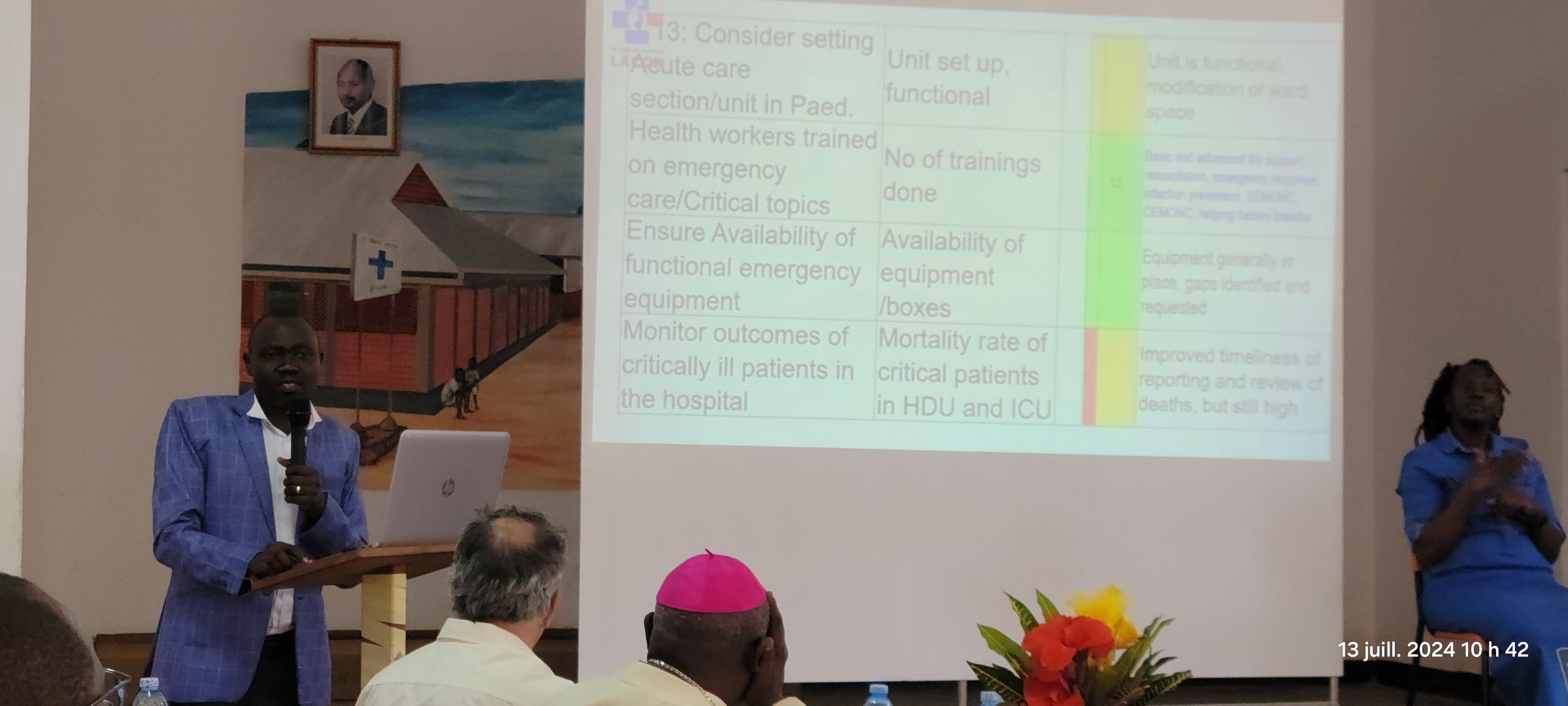
Institutionalization of quarterly quality audits, with the participation of external evaluators. More than 200 indicators are verified, many of which are made up of several different elements that need to be measured.
-
The introduction of full transparency whereby audit results are shared with funders in order to adjust the payments the hospital receives on a quarterly basis.
Program management and control tools include:
-
Grant memoranda signed with each strategic funder that provide for payments in arrears, when the funder is satisfied with the documentation submitted. Additional inspections prior to the disbursement of funds may take place. The memoranda include an appendix that gives the proposed base amount ("the reward") for each service and another that gives the weighting of the pre-established quality multipliers on the grant, based on the level of quality achieved.
Both appendices are derived from the original NU-Health documents.
-
The verification tool, detailing the procedure for quarterly evaluations.
-
The calculation tool, which elaborates the verified data and generates the formal request for release of the subsidy.
-
The second-level indicator calculation tool, indicating the overall impact of RBF donor support in terms of accessibility and quality of services for the entire hospital.
The procedures of the RBF program are subject to a continuous improvement process. Any changes must be agreed to by amending the annexes to the funding memorandum and the mechanism to achieve this is by necessity flexible.


