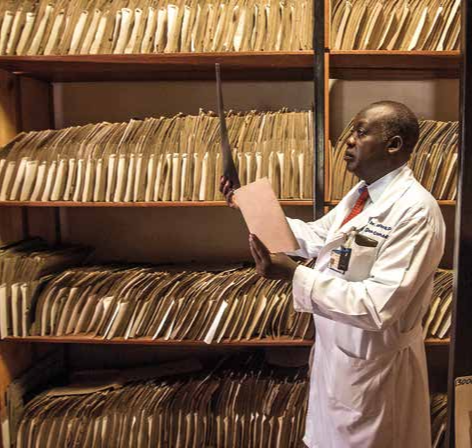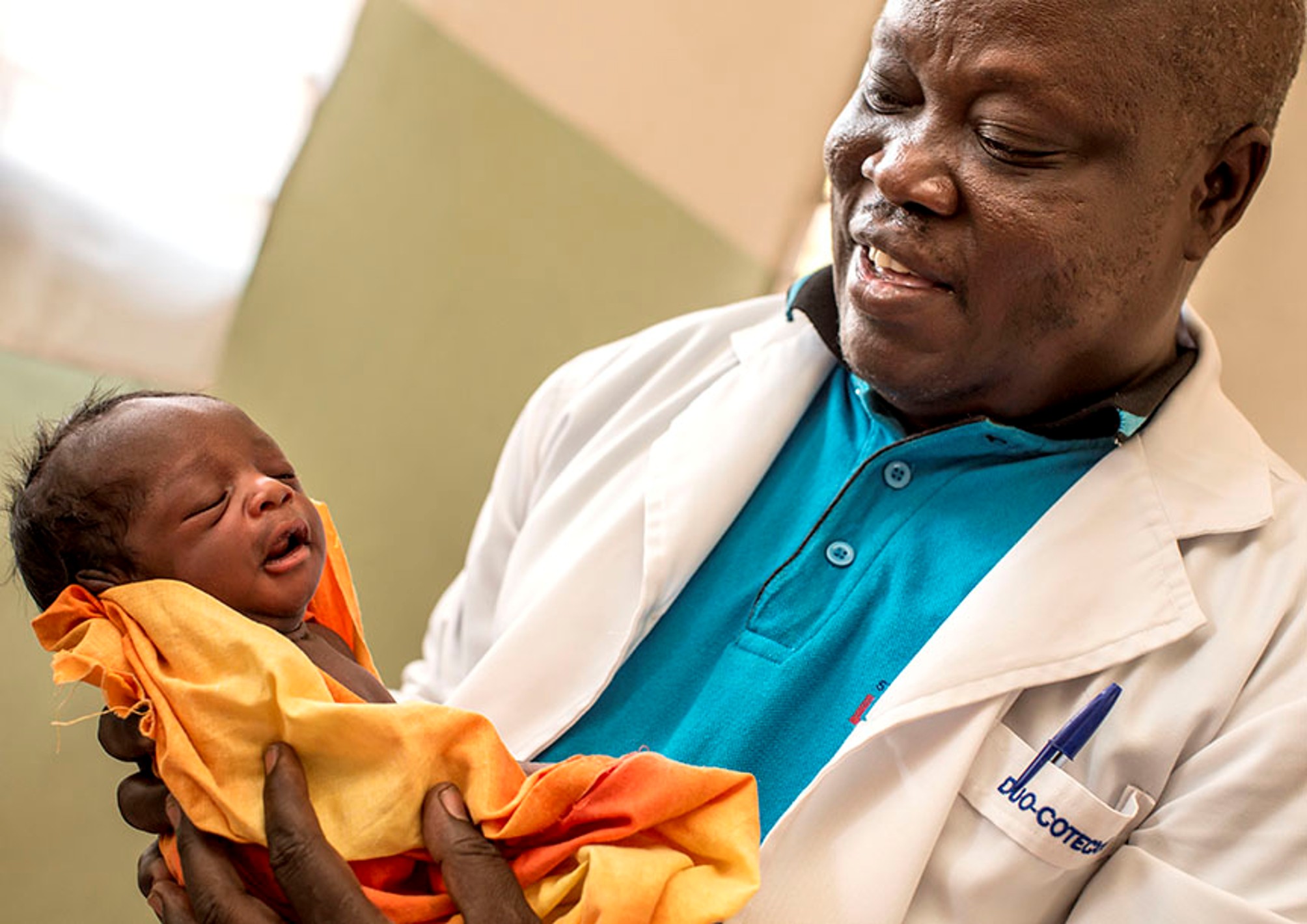
This year marks the 30th anniversary of Lucille’s death, which occurred on August 1, 1996. During a recent mission to Lacor, we remembered her through a long conversation with Dr. Odong, the medical director and gynecologist, and Dr. Martin, the institutional director and surgeon. The result was a rich and intense dialogue that we are pleased to share with you.
“Dr. Lucille was one of the people who inspired me to become a doctor,” says Dr. Odong. “One day I went to visit my father, who was hospitalized at Lacor. I was wearing my Gulu High School uniform when I met a young woman in a white coat; she asked me who I was and urged me to study hard and become a doctor. Those words stuck with me. After finishing high school, I enrolled at Makerere University in Kampala and graduated in 1986. One day, Dr. Matthew Lukwiya came to our resident housing looking for young doctors for Lacor. I accepted. I began working with Lucille in the outpatient clinic, on the ward, and in the operating room.
 |
|
Lucille with Sister Pierina Asienzo, an anesthesia technician who died of Ebola in 2000; Dr. Matthew Lukwiya and eleven other colleagues also died of the disease. |
She and Dr. Corti were completely devoted to the hospital. Lucille had an impressive memory: she remembered every patient she had seen in the outpatient clinic very well and would ask about their condition. There were only three of us interns, and we worked in every ward of the hospital. At night, there was only one doctor on call for the entire hospital.”
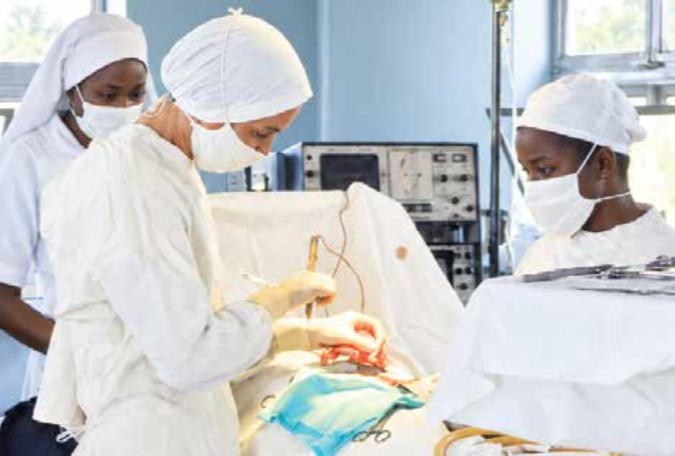
“I arrived at Lacor in 1990,” says Dr. Martin. “The first thing I noticed about Lucille was her great willingness to teach. She was always there, 24 hours a day, and she was happy if you called her for advice: she’d come and tell you what to do; she was very quick to make decisions and solve problems. These weren’t theoretical lessons; they were practical lessons, applied to patients… and then you could see the results firsthand…” “In the operating room,” Dr. Odong continues, “she gave you confidence, but she wanted to maintain control, and she showed you everything step by step, held your arm, and taught you the movements.”
“And she wanted you to do things a certain way,” Dr. Martin echoes. “If you were slow at tying knots, she’d say, You have to learn! Take these sutures home, practice, and you’ll see—by tomorrow you’ll know how to do them. She was also very strict about certain details: if you were holding a retractor, you had to keep it still in a specific way; as soon as you moved, she’d call you out on it—so much so that we nicknamed her Don’t Move! But she could perform any kind of surgery, from head to toe, even on children.
It was incredible because she was… superhuman. She handled an impressive workload: when I arrived, she was working as a surgeon, a gynecologist, and even an internist. In the morning, she’d make her rounds of the hospitalized patients and then see outpatients. At two o’clock, she’d head to the operating room: general surgery on Tuesdays and Thursdays, and gynecological surgeries on Wednesdays and Fridays.”
 |
|
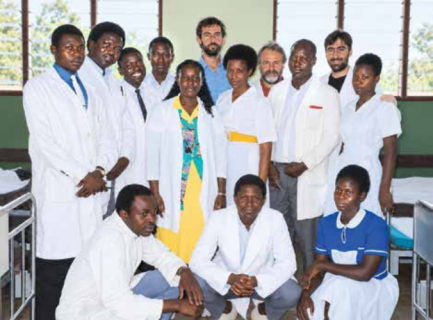
Plastic surgeons from the Fatebenefratelli Hospital in Milan with their colleagues from Lacor. Standing, from the left: first is Dr. Martin Ogwang; third is Dr. Joses Komakech, a maxillofacial surgeon; sixth is Sister Millie Among, who served as director of nursing for many years; and ninth is Dr. Emintone Odong. |
“In the operating room, we worked late into the evening; we had many emergencies and often operated even at night,” says Dr. Odong. "There was a war going on, and we were seeing many abdominal injuries and serious cases. We weren’t always able to save them. And then there were about 150 deliveries a year, plus the pediatric clinic and all the other work. But the hospital was smaller, and we managed to handle it all. Every week, we’d all go around together to check on the patients: Dr. Corti mainly handled radiology and pediatrics, but Dr. Lucille was the lead physician. Dr. Corti was the one who handled the logistical aspects; he was always walking around the hospital to supervise everything and, when necessary, call people out. Sometimes, when pointing out things that weren’t going well, they were very direct, but very kind.”
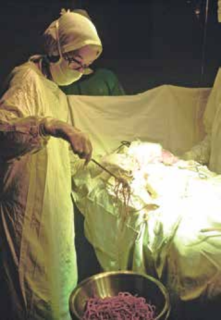
“I learned a lot during that time,” says Dr. Martin. “There were many trauma cases, assaults, and children with fractures, and pyloric obstructions caused by ulcers, so we were able to get a lot of practice with gastrointestinal sutures and gastroscopy, which was taught to us by an Italian doctor, Dr. Ronchetti. Today, anti-ulcer medications, such as omeprazole, have virtually eliminated this disease. We had various cases of tropical soft-tissue diseases that were rarely seen at the university hospital and are now almost never seen, and we had to learn plastic surgery techniques. There were devastating cases of breast cancer, intestinal torsion, abdominal tuberculosis, peritonitis, and intestinal obstructions caused by adhesions or even worms. The latter were quite shocking, and the nurses would flee in horror. I remember that once Lucille operated on a young boy whose intestine was obstructed by 496 roundworms twisted together [Ed.: worms that can reach 40 cm in length]. They looked like spaghetti, and there was a whole basin full of them. She was very proud of this because she had broken every record reported in the literature. Several children had anorectal malformations, especially Hirschsprung’s disease, a congenital condition that causes massive dilation of the colon. Lucille took them very much to heart. She had heard about a new technique developed by Prof. Soave of Genoa that guaranteed a good quality of life for the children, so she wrote to him to invite him to come and operate on a few cases and teach her the technique. The professor’s wife replied that her husband would certainly have accepted the invitation, but unfortunately, he had passed away. We had to make do with the descriptions in scientific articles. There was truly a lot of work, but Lucille was very organized and methodical: the results were tangible, and we learned a great deal.”
“The Cortis took very good care of us,” recalls Dr. Odong. “Back then, there was very little. Sometimes Dr. Corti would give jeans to the doctors, and the Matron [Ed.: head nurse] would give us some rice. Those were difficult times, and people really appreciated that someone was taking care of them. Then Dr. Corti suggested that I specialize in obstetrics and gynecology. I received a scholarship and went to Makerere, but it was very difficult there because there was a lot of segregation among the various tribes, and the director didn’t like us because we had already gained a lot of experience at Lacor—even with conditions they rarely encountered. So I went to Zimbabwe. In 1998, I returned to Gulu. My years of specialization had coincided with the worst period of the guerrilla war, marked by massive population displacements as people fled the countryside and refugee camps were established. My family, too, had had to leave the village to seek shelter in the city. It was during that time that my mother died and I got married.”
“The war was intensifying,” Dr. Martin interjects, “and we had to deal with war surgery. More and more gunshot wounds were coming in, with all sorts of injuries, and then the landmines started appearing. I had left to specialize in surgery in July 1993.
 |
 |
|
From Lucille’s diary, 1991: “October 12… at 8 a.m., operated on a roundworm obstruction… counted 400 worms!” |
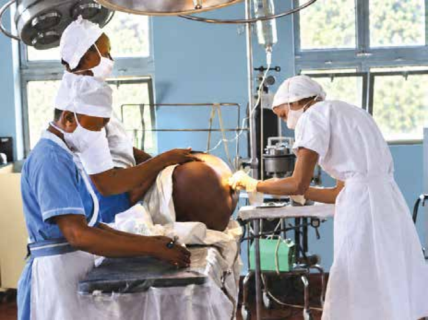
For many years, Lucille personally administered spinal anesthesia to the patients she would later operate on. |
The operating wing had expanded: we now had five operating rooms with a sterilization unit. Many children with severe burns were also being admitted—they would reach into pots and end up in the fire. Even if the burn healed, significant scars remained that prevented, for example, the eyelids from closing or the arms from moving. During that time, a team from Fatebenefratelli helped us begin reconstructive plastic surgery. When the team was due to arrive, we would gather the patients, but there were always too many, and their hospital stays were very long.
At that time, there was no screening for cervical cancer: many women were reluctant to undergo a vaginal exam, and we saw many cases of cervical cancer. We had radiation therapy, and many cases were also treated surgically—sometimes with unconventional procedures—but I am convinced that these saved many lives.
Lucille was direct with patients—to the point of seeming rude—but she told them the truth. Later, I learned that if you tell patients the truth, no one will blame you.
There was a high rate of female infertility in the region [Ed.: which led to severe discrimination]. We had no proof, but we were convinced that schistosomiasis was one of the causes [Ed.: a disease caused by worms that is contracted by swimming in contaminated lakes or rivers]. To confirm the diagnosis, we needed to perform rectal or vaginal biopsies, and then we would administer praziquantel. Lucille would say, A woman comes in who can’t have children; I treat her for schistosomiasis, and she gets pregnant! The government didn’t launch a program to eradicate it until the 2000s, distributing praziquantel on a massive scale. Lucille had set up a system that worked well. She quickly trained young doctors to perform the most common emergency and elective procedures, and this saved us during the war.
Lucille had contracted AIDS during her many emergency surgeries, but Dr. Isaac had also arrived, so I left to pursue my residency. I liked Dr. Lucille: she was clear and direct; you didn’t have to guess what she was thinking. She’d call you in, tell you what she wanted and why she wanted it done that way, and finally state outright that as long as she was in charge, that’s how it would be done.
She had a culture of thrift, which isn’t common here. People use things and don’t take very good care of them.”
“Back then, supplies were scarce,” Dr. Odong interjects. “Gloves, syringes, and needles were sterilized and reused. We made our own saline and glucose solutions for IVs, and we used washed and sterilized Coca-Cola glass bottles as containers. Lucille would sometimes buy spools of nylon fishing line from Canada; once sterilized, it worked perfectly as suture thread.
We didn’t have many infections, but the advent of AIDS and then the Ebola epidemic in 2000 changed everything: we switched to disposable supplies, but at great financial cost.
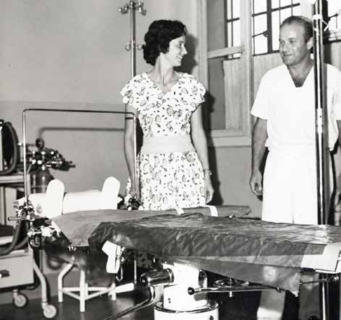 |
| Lucille and Piero in the operating room. Whenever general anesthesia was needed, it was Piero who administered it. |
The war had been very stressful: it was dangerous to move around, and patients arrived late. At Lacor, Dr. Matthew had remained to help the Cortis manage the hospital. The worst moment came when the rebels kidnapped Matthew and several nurses. The Cortis were on the verge of closing the hospital. In the end, due to pressure from the elders and the local population following the threat of the hospital’s closure, the rebels released Matthew and the nurses.
Lucille, despite being ill with AIDS, continued to work extensively in the outpatient clinic, but she had gradually handed over the surgical and gynecological work to Martin and me.
In the early 1990s at Lacor, obstetric and gynecological surgery consisted mainly of C-sections and other emergencies; however, I had begun treating obstetric fistulas [Ed.: a connection between the vagina and the bladder, or the vagina and the rectum, resulting from childbirth trauma]. It was a common problem, but one neglected by almost everyone because the surgery was particularly difficult. Lucille, on the other hand, tried to repair them, and I had begun to take an interest in the issue. So I gained a great deal of experience, and to date I have been able to restore quality of life and dignity to at least a thousand women. President Museveni recognized my work with a medal.
Lucille’s illness was worsening; she had drastically reduced her surgical workload, entrusting it first to Dr. Isaac and then to Dr. Martin, but she continued her outpatient practice. During the worst moments, she would take a break at lunchtime, get an IV, and return to work."
“But she was someone who knew how to balance work and rest,” says Dr. Martin. “When Matthew, Isaac, and I would go to the Corti home, Lucille would be sitting there in an armchair or on the bed, reading a book. She always had a book to read. We’d talk with Dr. Corti, and she’d listen; she rarely joined in the conversation, but when she did, she’d express her opinion.
I remember a funny incident: once, when my house was full of cockroaches, I sprayed a lot of insecticide, but I had a reaction—I was sweating profusely and felt dizzy. I told Lucille I couldn’t go on with it, and she replied, My son, don’t kill yourself—it’s pointless. This is a struggle for life, and the cockroaches will keep coming and fighting you until you decide to leave them alone. She was very protective and motherly toward us: once, the war had intensified greatly, and we wanted to leave the hospital. She told me, In Gulu, you’re only safe now if you’re protected by a wall. It’s very dangerous outside. If you want my advice, stay within the hospital walls. She called them walls, but in reality, back then there was only a metal fence… but somehow it offered protection.
In the end, she didn’t make it, and her illness, along with its complications, took her from us. At her funeral, there were hundreds of people who had come from far away on foot, despite the guerrilla fighting, which was fierce at that time. The army had sent a tank to protect the gathered crowd. Dr. Corti, without Lucille, was heartbroken and suffered greatly from loneliness; he read and reread her letters. Brother Elio and Matthew were particularly close to him. Dr. Matthew had become everyone’s point of reference. And we worked as before."
Now Lucille, Piero, Matthew, and Elio all rest together beneath the large tree planted in the heart of the hospital, which continues to thrive despite its never-ending problems, yet also with its prodigious and providential vitality.